Nafeesa Parveen
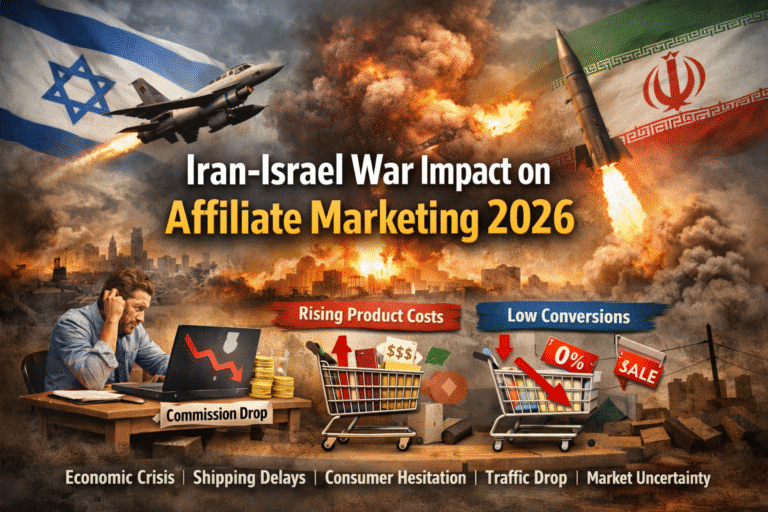
The Iran-Israel conflict in 2026 is causing rising product prices, lower conversions, and reduced affiliate marketing income globally.
💰 Iran-Israel War Impact on Affiliate Marketing 2026
📖 Introduction
In 2026, the ongoing Iran-Israel war has evolved into more than just a geopolitical conflict—it has become a major economic force influencing global markets, businesses, and digital income streams. Among the many sectors affected, affiliate marketing has experienced significant disruption.
Affiliate marketers across the world are noticing a clear pattern: even though website traffic remains steady or is increasing, conversions are falling and earnings are declining. This unexpected shift is confusing many beginners and even experienced marketers. However, when we look deeper, the reasons become clear.
The war has triggered a chain reaction involving oil prices, shipping costs, inflation, and consumer behavior. All of these factors are directly or indirectly connected to how affiliate marketing works. Understanding this connection is crucial if you want to survive and grow in the current environment.
🌍 Global Economic Instability and Its Ripple Effect
War in a critical region like the Middle East disrupts global economic stability. Iran plays a vital role in oil production and supply routes, and any tension in this region creates uncertainty in global markets. Investors become cautious, businesses slow down expansion, and economic growth weakens.
When economies become unstable, consumer confidence drops. People begin to worry about future expenses, job security, and rising costs of living. As a result, they reduce unnecessary spending. Iran-Israel War Impact on Affiliate
Affiliate marketing is deeply dependent on consumer purchasing behavior. When people stop spending freely, affiliate sales naturally decline. This is why many marketers in 2026 are experiencing reduced commissions despite consistent effort.
⛽ Rising Oil Prices and the Cost Chain Reaction
One of the most immediate consequences of the war is the rise in oil prices. Oil is the backbone of global trade and logistics. It powers transportation systems, manufacturing processes, and supply chains. Iran-Israel War Impact on Affiliate
When oil prices increase, it creates a ripple effect across multiple industries:
- Transportation becomes more expensive
- Shipping costs rise
- Manufacturing expenses increase
- Packaging materials cost more
All these factors contribute to higher product prices in the e-commerce market. For affiliate marketers, this creates a major challenge because higher prices reduce the likelihood of conversions.
Customers who were once ready to buy quickly now hesitate, compare alternatives, or delay their decisions.
🛒 E-commerce Price Increase and Its Direct Impact
E-commerce platforms are heavily dependent on global logistics. When shipping costs rise and supply chains are disrupted, product prices increase.
This has a direct impact on affiliate marketing:
- Higher prices lead to fewer purchases
- Customers become price-sensitive
- Cart abandonment rates increase
For example, a product that was previously affordable may now seem expensive to the average buyer. Even if users click on affiliate links, they may leave the page without completing the purchase.
This results in a drop in conversion rates, which is one of the biggest challenges in affiliate marketing during 2026.
📉 Conversion Rate Decline: The Core Problem
Conversion rate is the heart of affiliate marketing. Without conversions, traffic has no value.
In the current scenario:
- Traffic may remain stable
- Engagement may still exist
- But conversions are falling
This creates a frustrating situation for marketers. They continue to create content, drive traffic, and promote products, but their earnings do not reflect their efforts.
The main reason behind this is uncertainty. Customers are no longer making quick decisions. They take more time to evaluate purchases and often postpone them altogether.
💸 Changing Consumer Behavior in Times of Crisis
Consumer psychology changes significantly during times of war and economic uncertainty.
Earlier, online shopping was driven by convenience and desire. People bought products not only for their needs but also for comfort, trends, and lifestyle improvements. Iran-Israel War Impact on Affiliate
In 2026, priorities have shifted:
- Essential goods are preferred over luxury items
- Budget-friendly options are more popular
- Spending is more controlled and intentional
Impulse buying, which is a key driver of affiliate sales, has decreased sharply. This change alone has a massive impact on affiliate marketing performance. Iran-Israel War Impact on Affiliate
🚚 Shipping Delays and Loss of Customer Trust
The war has disrupted major global shipping routes, forcing companies to find alternative paths. These routes are longer, more expensive, and less efficient.
As a result:
- Delivery times have increased
- Logistics systems are under pressure
- Orders are often delayed or canceled
Customers today expect fast and reliable delivery. When that expectation is not met, trust begins to decline. Iran-Israel War Impact on Affiliate
For affiliate marketers, this is a serious issue. Even if a customer clicks on a link and shows interest, uncertainty about delivery can stop them from completing the purchase.
🌐 Supply Chain Disruptions and Product Availability
Iran-Israel War Impact on Affiliate Modern supply chains are complex and interconnected. A single product may involve multiple countries for raw materials, manufacturing, and distribution.
The war has disrupted this system:
- Raw materials are delayed
- Production slows down
- Finished goods take longer to reach markets
This leads to product shortages and higher prices. When products are either unavailable or overpriced, affiliate marketers struggle to promote them effectively.
Customers may search for alternatives, delay purchases, or avoid buying altogether.
📊 The Growing Gap Between Traffic and Revenue
One of the most noticeable trends in 2026 is the widening gap between traffic and revenue.
Websites may still attract visitors, but those visitors are not converting into buyers.
This happens because:
- Users are researching before buying
- Economic uncertainty causes hesitation
- Prices discourage immediate purchases
This “high traffic, low conversion” situation is one of the defining challenges of affiliate marketing in 2026.
🌐 Digital Disruptions and Online Marketing Challenges
War is not limited to physical conflict—it also affects the digital world. Increased cyber activity, internet restrictions, and technical disruptions can impact online platforms.
Affiliate marketers may face:
- Website downtime
- Reduced ad performance
- Tracking and analytics issues
These problems make it harder to run effective campaigns and measure results accurately.
🔥 Opportunities Hidden Within the Crisis
Despite the challenges, not everything is negative. Crises often create new opportunities for those who are willing to adapt.
Certain niches perform better during economic uncertainty:
- Budget and discount products
- Essential goods
- Digital tools and services
- Online courses and education
- Remote work solutions
Digital products, in particular, offer a major advantage. They do not depend on shipping, can be delivered instantly, and often have higher profit margins.
Affiliate marketers who shift their focus to these areas can still generate consistent income. Iran-Israel War Impact on Affiliate
🧠 Smart Affiliate Marketing Strategies for 2026
To succeed in the current environment, marketers must adapt their strategies:
- Focus on value-driven and affordable products
- Promote digital and subscription-based services
- Build trust through honest reviews and comparisons
- Invest in SEO for long-term organic traffic
- Diversify income sources across multiple platforms
Adaptability is the key to survival in this changing landscape. Iran-Israel War Impact on Affiliate
Stunning Design & Display
Samsung ka Ultra series hamesha se apne premium design ke liye famous raha hai, aur Galaxy S26 Ultra is tradition ko aur aage le jaata hai.
🔮 Future Outlook of Affiliate Marketing – Iran-Israel War Impact on Affiliate
The future of affiliate marketing in 2026 depends on how global conditions evolve. If the conflict continues, economic pressure may increase, leading to further challenges.
Even if the situation improves, recovery will take time. Supply chains need to stabilize, prices must normalize, and consumer confidence has to return.
Affiliate marketing will not disappear, but it will continue to evolve. Marketers who understand these changes and adjust their strategies will be better positioned for long-term success. Iran-Israel War Impact on Affiliate
✅ Conclusion – Iran-Israel War Impact on Affiliate
The Iran-Israel war in 2026 has created a powerful chain reaction affecting affiliate marketing worldwide. Rising oil prices, increased product costs, disrupted supply chains, and changing consumer behavior have all contributed to declining conversions and earnings. Iran-Israel War Impact on Affiliate
However, affiliate marketing is not ending—it is transforming. Those who remain flexible, understand market trends, and adapt their approach can still thrive even in difficult conditions. Iran-Israel War Impact on Affiliate
About The Author

 Vishal Ma