Vishal Ma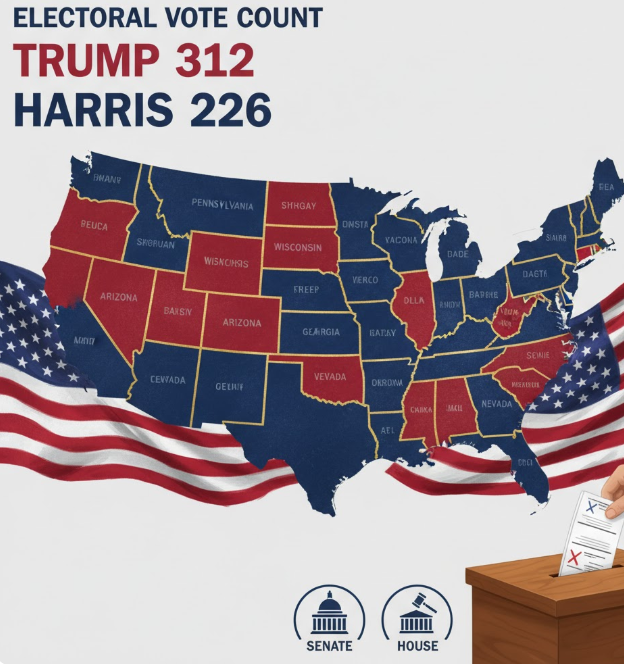
Visual representation of the 2024 U.S. presidential election results, highlighting key swing states and the final electoral vote count
2024 U.S. Election Results: Complete Analysis and Implications
2024 U.S. Election Results. The 2024 United States general election turned out to be one of the most consequential political events in recent history. It reconfigured power in Washington, reshaped party dynamics in key states, and set the stage for the next chapter of American politics. Below, we dive deep into what happened — who won, how they won, and what it means for the future. 2024 U.S. Election Results.
1. Overview of the Election Results- 2024 U.S. Election Results
-
Winner: Donald J. Trump (Republican) Wikipedia+2FEC.gov+2
-
Runner-up: Kamala Harris (Democrat) Wikipedia+1
-
Electoral Votes: Trump – 312, Harris – 226 Wikipedia+1
-
Popular Vote:
-
Senate: Republicans flipped seats to gain a majority. Wikipedia+1
-
House: Republicans retained control. Wikipedia+1
2. Why Trump’s Win Is Significant- 2024 U.S. Election Results
2.1 A Historic Comeback
Trump’s victory in 2024 marks a major political comeback. After losing the 2020 election, he returned to the White House with a solid electoral-college margin. Wikipedia+1 Importantly, he won all seven key swing states: Pennsylvania, Georgia, North Carolina, Michigan, Arizona, Wisconsin, and Nevada. Wikipedia
2.2 Not a Landslide — But Decisive Enough
While 312 electoral votes is a comfortable margin, analysts note that Trump’s victory was not a landslide in the historical context. Al Jazeera The popular vote margin was modest (~1.6 percentage points as of late count), making this one of the tighter wins in recent decades. Al Jazeera
2.3 High Voter Turnout & Engagement
Voter turnout was strong, reflecting high political engagement across the U.S. More voters participated than in many past elections, and early voting and mail-in ballots again played a critical role. While exact turnout percentage varies by report, the high volume of votes underscores the election’s significance. HERALDO USA+1
3. State-by-State Breakdown: Key Battlegrounds- 2024 U.S. Election Results
Certain states, often called “swing” or “battleground” states, decided the election. Here are the most important ones:
| State | Winner | Margin / Key Details |
|---|---|---|
| Pennsylvania | Trump | ~50.37% vs. 48.66%. This was critical: flipping Pennsylvania gave Trump a major boost in electoral votes. Wikipedia |
| Georgia | Trump | A tightly contested state with large political weight. The Times of India |
| Michigan | Trump | Won by leveraging rural/suburban voters. The Times of India |
| Wisconsin | Trump | Another key Midwestern state that swung red. The Times of India+1 |
| Arizona | Trump | 11 electoral votes; a decisive battleground. HERALDO USA |
| Nevada | Trump | Important as the GOP flipped it; he secured just over 50% according to some reports. The Guardian |
| North Carolina | Trump | Strong GOP performance, further consolidating his campaign in the South. The Times of India |
These states, combined, gave Trump the electoral edge he needed.
4. The Popular Vote: Close but Clear- 2024 U.S. Election Results
Though Trump won decisively in the Electoral College, the popular vote was much tighter.
-
Trump got approximately 49.8% of the vote. Wikipedia
-
Harris got around 48.3%. Wikipedia
-
According to Al Jazeera, Trump’s margin of ~1.62% (in late-count totals) was one of the narrowest for a winner in the 21st century. Al Jazeera
-
By raw vote count, hundreds of thousands of ballots separated the two, making it a hard-fought race.
5. Senate Results: Republicans Take the Upper House
Beyond the presidency, the Senate changed hands, giving Republicans more control in Congress.
-
Seats contested: 34 (33 regular + 1 special) in 2024. Wikipedia
-
Seat Change: Republicans gained +4 seats. Wikipedia+1
-
After the election, Republicans secured a 53–47 majority (counting those who caucus in). National Association of Counties
-
Key defeats for Democrats included sitting Senators in Montana, Ohio, and Pennsylvania. FDRA+1
-
This gain is especially notable: it’s the first time since 1980 that Republicans flipped a chamber of Congress in a presidential election year. Wikipedia
Having the Senate gives Trump (and the Republicans) more leverage for nominating judges, influencing legislation, and shaping the agenda for the next two years.
6. House of Representatives: Republicans Hold On
-
Total seats: 435 (all up for election). Wikipedia
-
Republicans secured 218 seats, the threshold for a majority. AP News+1
-
According to AP News, this victory “completes the party’s sweep into power” — with control of both the White House and one or both chambers of Congress. AP News
-
However, while they held the House, their majority is not overwhelmingly large, leaving some risk of internal divisions or resistance.
7. What Drove the Republican Wins?
Several strategic, demographic, and issue-based factors helped Republicans pull off a strong performance in 2024:
-
Targeting Swing States
-
Economic Messaging
-
Inflation, job growth, and cost of living were major voter concerns. The Republicans emphasized tax cuts and deregulation in their campaign.
-
-
Immigration and Border Policy
-
Migration and border control remained hot-button issues. Trump’s strong rhetoric and proposed policies resonated with large voter blocs, especially in swing states.
-
-
Demographic Shifts
-
There was visible realignment in certain working-class and suburban communities. Some Latino and non-metropolitan voters moved toward the GOP in key states.
-
Rural and exurban turnout remained high for Republicans, reinforcing their base.
-
-
Turnout Strategy
-
High Republican turnout combined with efficient ground operations. Early voting and in-person voting on Election Day helped boost their numbers.
-
At the same time, down-ballot “drop-off” (voters supporting Trump but not necessarily Republican candidates in other races) may have played a role in some Senate/House results.
-
-
Campaign Infrastructure
-
The Republican Party, and Trump’s campaign machine, put a lot of resources into voter mobilization, persuasion, and advertising in the battleground areas.
-
8. Implications of the Results
8.1 For Domestic Policy
With control of the presidency and a Senate majority, Republicans are well-positioned to push their legislative agenda. Some likely policy domains:
-
Judiciary: Trump may nominate more conservative judges, shaping courts for years.
-
Immigration: The administration may pursue stricter border measures and reform policies.
-
Taxes & Economy: Potential for significant tax cuts, deregulation, and pro-business reforms.
-
Social Programs: Debates over spending on social services, healthcare, and education will likely intensify.
8.2 For Congress
-
The Republican-controlled Senate may play a key role in confirming appointments and blocking or passing legislation.
-
In the House, although Republicans have the majority, their slim margin means they’ll need to manage internal disagreements carefully to pass major reforms.
8.3 For the Democratic Party

-
The loss is a major blow, particularly given the high stakes. Democrats will need to reassess their strategy, especially in swing states.
-
The party may focus more on rebuilding coalitions in urban areas, recapturing working-class voters, or rethinking messaging on economic issues.
-
Potential leadership changes could emerge, with a push to bring fresh faces or new policy priorities.
8.4 On Global Stage
-
A Trump administration backed by a Republican Congress could shift U.S. foreign policy: stronger posture on trade, alliances, and immigration.
-
The perception of American political stability — given the return of a former president — may influence markets, global diplomacy, and investor sentiment.
-
International partners will watch closely how this government balances domestic priorities with its global role.
9. Challenges Ahead & Risks
While the results are a clear win for Republicans, they also come with significant challenges:
-
Governing with a Narrow Majority
-
A slim Senate majority means passing controversial bills could be difficult, especially if intra-party divisions emerge.
-
The House majority is similarly narrow, which could limit the scale or speed of reforms.
-
-
Public Expectation vs. Reality
-
Trump’s campaign made big promises on immigration, deportations, and tax cuts. Delivering on all of them — especially with legislative constraints — is not guaranteed.
-
There could be backlash from those opposed to aggressive policy moves, both domestically and internationally.
-
-
Economic Risks
-
Aggressive tax cuts or deregulation may fuel short-term growth but could also raise concerns about deficits or inflation later.
-
Any mismanagement could lead to voter dissatisfaction in future elections.
-
-
Factionalism within the GOP
-
The Republican Party is not monolithic: there are traditional conservatives, populists, and moderates. Reconciling these factions will be crucial for stable governance.
-
Overpromising on radical change may alienate more moderate Republicans or centrists.
-
-
Democratic Resurgence?
-
Democrats will likely regroup and mobilize — especially in states they narrowly lost.
-
The 2026 midterm and 2028 presidential cycles will be pivotal in determining whether this Republican consolidation holds or fractures.
-
10. Historical Context & Comparisons- 2024 U.S. Election Results
-
Trump is now one of the few U.S. Presidents to serve two non-consecutive terms. FDRA+1
-
His Electoral College margin (312-226) is strong, but not a blowout when compared to historical landslides. Al Jazeera
-
The popular vote margin (~1.6%) is among the narrower winning margins — smaller than many modern landslides. Al Jazeera
-
The Democratic losses in the Senate are particularly significant: flipping four seats in a presidential year is a strong performance for Republicans, historically notable. Wikipedia+1
11. Lessons for Future Elections
From the 2024 election, several broader lessons emerge:
-
Swing States Still Matter
The battleground states again determined the outcome. Parties will continue investing heavily in these states in future cycles. -
Down-Ballot Dynamics Are Tricky
Success at the presidential level does not always guarantee proportional down-ballot wins. Republicans did well at the top, but internal party cohesion and strategy will be key for legislatures. -
Voter Mobilization Wins Elections
High turnout, especially in strategic demographics and regions, remains decisive. Both parties must maintain strong ground games, especially for early and mail-in voters. -
Messaging and Identity Politics Are Critical
Messaging around the economy, immigration, and cultural identity continues to shape voter behavior. Voters are not just choosing policies — they are choosing what they believe America’s future should look like. -
Governability vs. Promises
Winning is one thing; governing is another. Campaign promises need balancing with legislative realities. The 2024 results raise questions about how much of the campaign agenda can realistically be delivered.
12. What to Watch Next
-
Trump’s First 100 Days: What policy priorities will he push? Immigration, judiciary, and taxes are likely high on the agenda.
-
Senate Dynamics: Which bills will the Republicans try to pass? Will they be united enough to follow a bold agenda?
-
Democratic Strategy: How will the Democratic Party reposition itself for 2026 and 2028? Will there be generational change?
-
Midterm Elections: The 2026 midterms will be very important. If Republicans fail to deliver, they risk losing momentum.
-
Global Reactions: How will allied countries respond to a Trump return? What does this mean for diplomacy, trade, and international cooperation?
13. Conclusion
The 2024 U.S. election was not just a contest for the presidency — it was a referendum on America’s direction. With Donald Trump returning to office, backed by a Republican Senate and a narrow but sufficient House majority, the political landscape has shifted significantly.
While the win was decisive in terms of electoral votes, the relatively close popular vote shows that the country remains deeply divided. The new government faces both opportunity and risk: delivering on bold promises will require careful negotiation, internal unity, and strategic thinking.
About The Author




 Nafeesa Parveen